
AC Compressor Replacement Cost: What Homeowners Should Expect in 2026
The technician spent about twenty minutes with a gauge connected to the outdoor unit before coming back inside with the news. The compressor was done. Not a quick fix. Not a part swap. A full compressor replacement, with the number on the estimate having three figures before the decimal point, started to feel relevant.
That number can feel like a gut punch. A capacitor repair costs a few hundred dollars. A compressor repair runs into the thousands. The jump between those two numbers is jarring if nobody explains why.
Here is the short version. The compressor is the single most expensive moving part in your AC system. It is also the part most directly tied to refrigerant, which has gotten significantly more expensive since 2024 due to federal phase-down regulations. Both of those facts combine to make this one of the bigger repair bills a homeowner will face.
This guide breaks down what a fair AC compressor replacement cost looks like in 2026, what drives prices up or down, and the one decision that matters more than any other on this page: whether to repair the compressor or replace the whole system.

Quick Answer
Most homeowners pay $800 to $2,800 for AC compressor replacement in 2026, with $1,600 being a commonly cited national average for parts and labor combined. Larger systems, premium refrigerant types, or difficult access can push costs to $3,500 or more. If the compressor is still under the manufacturer’s warranty, you may only pay labor and refrigerant, often $600 to $1,200. Always get a written quote that separates the compressor, labor, and refrigerant cost.
These figures are for residential central air systems. If your search led you here looking for a car AC compressor, that is a different repair entirely, with a different cost structure. This guide covers only home and residential HVAC systems.
AC Compressor Replacement Cost by System Size
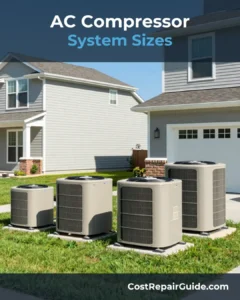
Compressor size is measured in tons of cooling capacity, and it is the single biggest driver of part cost. A larger home needs a larger compressor, which costs more in both parts and the refrigerant required to charge it.
These are installed totals, not part-only prices. The labor, refrigerant, and any additional components, like a filter drier or contactor, are typically included in a full compressor replacement quote.
System Size | Typical Total Cost | Common Home Size |
1.5 to 2 tons | $700 to $1,400 | Small homes, condos, mini-splits |
2.5 to 3 tons | $900 to $2,100 | Most common, average single-family home |
3.5 to 4 tons | $1,100 to $2,400 | Larger homes, 2,000 to 3,000 sq ft |
5 ton | $1,800 to $3,500 | Large homes or homes in hot climates |
What the Compressor Actually Does
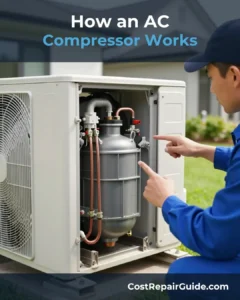
The compressor is the heart of your AC system. It pressurizes the refrigerant and pushes it through the system in a continuous cycle, which actually pulls heat out of your indoor air and releases it outside. Without a working compressor, the entire cooling process stops, even if every other part of the system is fine.
This is different from a capacitor failure, where the motor just struggles to start. A failed compressor means the AC cannot cool at all, regardless of what the thermostat says. See: AC Capacitor Replacement Cost for that more affordable, more common repair.
A well-maintained compressor typically lasts 10 to 15 years, sometimes 15 to 20 years in cooler northern climates. Hot southern climates tend to shorten that lifespan to 8 to 10 years because the system runs harder and more often.
Signs Your AC Compressor Has Failed
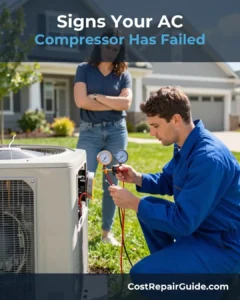
Important: these symptoms often mimic other, cheaper problems. A failing capacitor or a refrigerant leak can look identical to a compressor failure from the outside. Always get a licensed technician to inspect and diagnose before approving a compressor replacement, specifically.
What Drives AC Compressor Replacement Cost
System Size and Cooling Capacity
Larger compressors cost more in both materials and the refrigerant needed to charge them. A 1.5-ton system for a small home costs significantly less than a 5-ton system for a large house, even with identical labor involved.
Refrigerant Type and Current Pricing
This is the single biggest 2026 cost factor that catches homeowners off guard. R-410A refrigerant prices have climbed roughly 40 percent since 2024 due to EPA phase-down regulations limiting production. A 3-ton system typically needs 6 to 8 pounds of refrigerant, and at current pricing, that alone can add $1,200 to $2,000 to the bill. If your system still uses older R-22 refrigerant, the cost climbs even further. R-22 is no longer produced in the United States, and a full compressor replacement on an R-22 system can exceed $5,000.
Labor and Access
Professional installation labor typically runs $400 to $1,500, depending on your region and job complexity. Urban areas with higher costs of living see labor rates of $100 to $150 per hour, while rural regions often run $75 to $100 per hour. Rooftop units, tight mechanical rooms, or systems requiring custom refrigerant line work can add $200 to $800 to the labor cost.
Acid Contamination and Line Flushing
When a compressor burns out internally, which happens in most failures, the technician usually needs to flush the refrigerant line set with nitrogen to remove acid and contamination before installing the new compressor. Skipping this step risks contaminating the new compressor and causing it to fail early. Expect this to add $125 to $275 to the total bill.
Warranty Coverage
If your system is under 10 years old and was properly registered, the compressor itself may be covered under a manufacturer’s warranty, sometimes reducing the part cost to $0. You would still pay for labor, refrigerant, and any required components, typically bringing the total to $600 to $1,200 instead of the full replacement cost. Always check your warranty status before paying out of pocket.
Emergency or Peak-Season Timing
Compressors most often fail during the hottest part of summer, when the system is working hardest. Emergency replacements during peak season typically add 20 to 30 percent to the base cost. Scheduling non-emergency work in late fall or early spring, when demand is lower, can result in better pricing.
Cost Breakdown Example: Where the Money Actually Goes
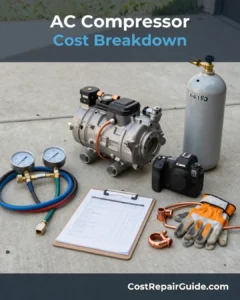
Here is a realistic breakdown for a typical 3-ton residential compressor replacement, based on current contractor field data.
Ask any contractor for a quote that separates these line items. A vague single total makes it hard to know whether you are being charged fairly for each component.
Item | Typical Range | Notes |
Compressor unit (part) | $400 to $1,200 | Brand and capacity dependent |
R-410A refrigerant (6-8 lbs) | $150 to $400 | Some sources report up to $1,200+ at current pricing |
Labor | $400 to $1,500 | 4 to 6 hours of skilled labor is typical |
Filter drier, contactor, TXV valve | $100 to $350 | Often replaced together with the compressor |
Acid test and line flush | $125 to $275 | Required if the compressor burned out internally |
Typical total bill | $800 to $2,800 | The national average is around $1,600 |
Why a Cheap Online Compressor Is Rarely a Good Deal
It is tempting to search for the compressor part online and ask a technician to install just the part to save money. Here is a real example of how that can go wrong.
One contractor described a customer who bought a compressor online for $650 and asked him to install it. The part came with zero warranty because it was not installed by a licensed contractor using a factory-authorized replacement process. When it failed four months later, the homeowner was out the original $650 plus the labor cost, and still needed a proper replacement done correctly. Total cost: roughly $3,800, compared to the $2,400 a complete professional quote would have cost from the start.
Cheap compressors are rarely cheap once you account for voided warranties and the real possibility of early failure.
Repair the Compressor or Replace the Whole AC System?
This is the most important decision on this page, and it deserves more than a quick gut reaction. A compressor replacement can run $800 to $2,800. A full new AC system runs $4,000 to $7,500 or more. The gap between those numbers is large, but it is not always the deciding factor.
One HVAC contractor with 20 years of field experience put it this way: when a compressor fails on an older unit, replacing the entire system almost always makes more financial sense, because the compressor alone can run up to $2,500 while a new energy-efficient system might cost $3,500 to $5,500. The price gap is smaller than most homeowners expect once the full compressor bill is on the table.

Your Situation | Better Choice | Why |
System under 8 to 10 years old | Replace compressor | Other parts likely have years of life left |
Compressor still under warranty | Replace compressor | Part cost may be $0; only labor applies |
System uses R-410A, otherwise healthy | Replace compressor | Good value if the rest of the system performs well |
The system is 10 to 12+ years old | Compare full replacement | Other components are approaching the end of their life, too |
The system uses R-22 refrigerant | Strongly consider replacement | R-22 is no longer produced; cost can exceed $5,000 |
Repair cost exceeds 50% of the new system cost | Full replacement | Better long-term value at that price point |
Questions to Ask Before Approving a Compressor Replacement
A technician who hesitates to answer the warranty and refrigerant pricing questions specifically is worth getting a second opinion on.
A Confession About Compressor Quotes
This is the repair that makes homeowners feel like they are being taken advantage of more than almost any other HVAC bill, and the reaction is understandable.
You knew the capacitor down the line cost under fifty dollars, and the bill was still a few hundred. Now the compressor quote is in the thousands, and there is no obvious physical object you can point to that explains the jump. It feels abstract. It feels like a number someone made up.
Here is what actually explains it. The compressor itself is the most expensive single part in the system. The refrigerant required to recharge it has gotten meaningfully more expensive since 2024 because of federal regulation, not because your contractor decided to raise prices. And the labor involved is genuinely more complex than a quick part swap, line flushing, acid testing, and multi-hour installation are real work, not padding.
None of that means every quote is automatically fair. It means the size of the number is not, by itself, evidence of anything. Ask for the itemized breakdown. That is what actually tells you whether this specific quote is reasonable.
How to Avoid Overpaying
Frequently Asked Questions
Final Thought
AC compressor replacement is one of the more expensive repairs a homeowner will face, typically running $800 to $2,800 in 2026, with refrigerant pricing playing a bigger role in that total than it did just a few years ago.
The size of the bill is not, by itself, a sign that something is wrong with the quote. Get an itemized breakdown separating the compressor, labor, refrigerant, and any required components. Check your warranty status before paying for the part. And before approving anything, ask the one question that matters most: given the age of this system, does replacing the compressor or replacing the whole unit make more financial sense?