
Circuit Breaker Replacement Cost: 2026 Prices and Signs of Failure
The microwave hums, the toaster pops, and then the entire kitchen goes dark. You walk to the panel, flip the breaker back on, and it clicks off again within seconds. Now you are trying to decide whether the breaker is failing or the circuit is simply overloaded.
That distinction determines your final bill. A worn breaker is usually a quick and inexpensive swap. A circuit that trips for another reason can lead to larger repairs. The circuit breaker replacement cost stays modest in the first case. In the second, it depends on what the electrician discovers.
This guide separates the two situations clearly. You will see the part price, the installed price, and how AFCI, GFCI, and main breakers differ from standard ones. You will also learn the warning signs of a failing breaker. And you will see where the panel itself becomes the real problem.
All prices come from published 2025 and 2026 cost guides, plus one undated page that we flag. Your local quote will differ, so use these ranges to test a bid rather than to set a final budget.
Quick Answer: The circuit breaker replacement cost typically runs $150 to $250 for one standard breaker, parts and labor included. The part alone costs far less, often under $100. AFCI and GFCI breakers cost more, and a main breaker runs $200 to $300 when the bus bar is fine. A breaker that keeps tripping can cost $200 to $2,000 to solve.
How Much Is the Circuit Breaker Replacement Cost?
Most homeowners pay between $150 and $250 to have one breaker replaced. This Old House (June 2026) and Fixr (January 2025) both list that range. Other guides run lower, since NerdWallet and HomeAdvisor each list $100 to $200 for a breaker or fuse swap.
Thumbtack’s page offers a worked example. An electrician charged $100 for about two hours of labor and added a $20 breaker, for a total of $120. That figure sits at the low end of every guide reviewed here.
The spread comes from three factors. Your region sets the labor rate. The breaker type sets the part price. The company decides whether the service call fee is included. Ask for the all-in number before the visit so the final invoice holds no surprises.
Circuit Breaker Replacement Cost by Breaker Type
The part is the smallest piece of the bill, because standard breakers are inexpensive while safety breakers cost noticeably more. HomeServe’s June 2025 guide lists the following part prices.
| Breaker Type | Part Price (HomeServe, Jun 2025) | Common Use |
|---|---|---|
| 15 or 20 amp standard | $7 to $9 | Lights and outlets |
| 30 amp standard | $17 to $19 | Dryers and some appliances |
| 50 amp standard | $20 to $40 | Ranges and larger loads |
| 15 or 20 amp AFCI or GFCI | $60 to $90 | Bedrooms, kitchens, baths |
| 30 to 50 amp AFCI or GFCI | $100 to $250 | Large appliance circuits |
Other guides report different part prices. This Old House lists AFCI and GFCI breakers at $35 to $60 each. Fixr lists GFCI breakers at $5 to $100 and AFCI breakers at $50 to $100. The ranges overlap, so shop by model and not by category.
The part price is not what you pay. An electrician adds labor, a service call fee, and sometimes a markup on parts. That is why a $9 breaker can appear as a $150 line item.
Parts, Labor, and Fees: What the Bill Includes
A breaker swap has four cost pieces. Understanding them helps you compare any circuit breaker replacement cost quote fairly.
- The breaker: usually $7 to $250 depending on type.
- Labor: typically one hour or less for a straightforward swap.
- The service call fee: Angi lists $100 to $200 for most visits.
- A minimum charge: some companies bill one to four hours for small jobs.
Thumbtack notes that wiring work often runs $40 to $50 per hour, rising to $90 in some areas. Angi and This Old House list higher licensed-electrician bands. Our electrician cost per hour guide explains why those numbers differ.
Fixr lists installed breaker switches at $200 to $250 with labor included. That number sits at the top of the range because it assumes an electrician-grade visit.
Why Breakers Trip
A breaker trips to stop too much current. It protects the wire inside your walls from overheating. Knowing why it tripped tells you what to fix.
Three causes explain most trips:
- Overload: too many devices on one circuit draw more current than the wire should carry.
- Short circuit: hot and neutral wires touch and current surges.
- Ground fault: current leaks to ground, often through water or damaged insulation.
The Consumer Product Safety Commission gives clear advice. It says not to simply replace a fuse or reset a breaker without finding out why it blew. It also warns against overloading any circuit with too many products.
A breaker that trips once during a heavy load may be doing its job. A breaker that trips repeatedly needs a diagnosis.
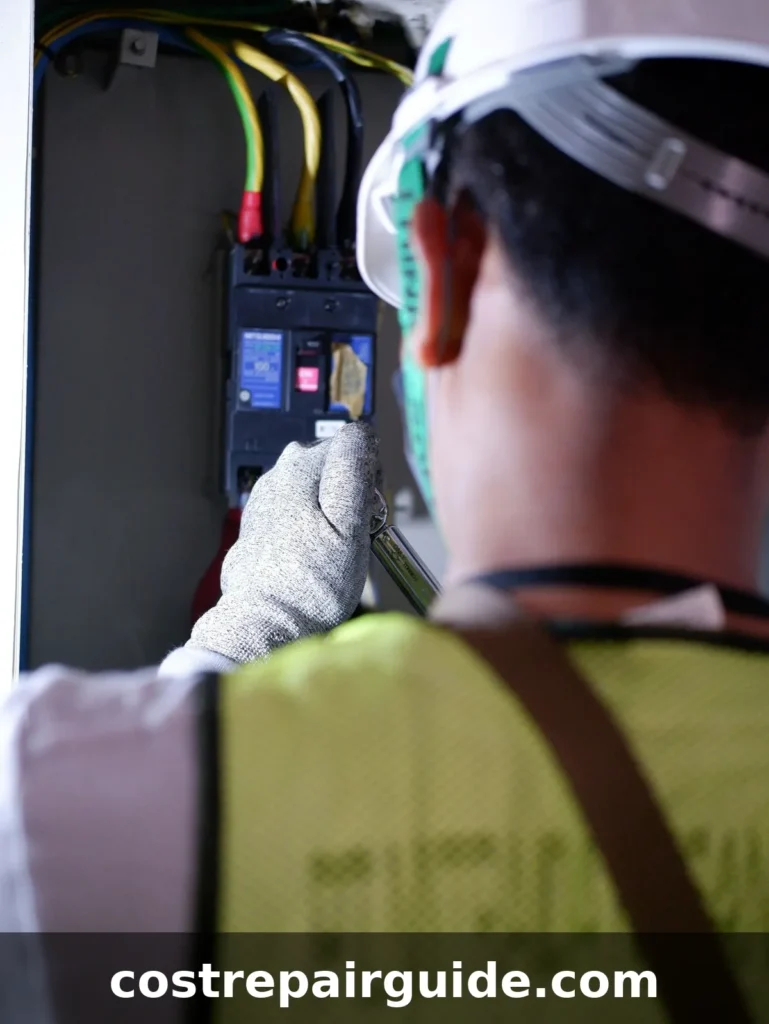
How a Circuit Breaker Actually Works
Knowing the basics helps you read an electrician’s explanation. Most household breakers combine two kinds of protection. A heat-sensing strip responds to a steady overload. An electromagnet responds to a sudden surge from a short circuit. Either one flips the handle and cuts power.
Every breaker carries an amperage rating. That rating must match the wire it protects. In common residential practice, a 15 amp circuit uses 14 gauge copper wire. A 20 amp circuit uses 12 gauge. A breaker rated too high for its wire will not trip before the wire overheats.
This is why the part price tells you so little. The value of the job lies in choosing the correct breaker and installing it tightly. It also lies in confirming that the circuit behind it is safe. A careful electrician checks all three.
Cost Examples by Situation
Real calls fall into a handful of patterns. The table matches each pattern with a likely fix and a range drawn from the guides above. Treat it as an illustration and not a quote.
| Situation | Likely Fix | Estimated Range |
|---|---|---|
| One branch breaker is worn | Swap the breaker | $150 to $250 |
| Main breaker is worn but the panel is sound | Swap the main breaker | $200 to $300 |
| Main breaker plus a damaged bus bar | Repair or replace internal parts | $500 to $2,000 |
| Breaker trips and the cause is unknown | Diagnose, then repair | $200 to $2,000 |
| Panel is old, hot, or corroded | Replace the panel | See the panel guide |
The first row is the most common. The last row is the most expensive. The circuit breaker replacement cost jumps whenever the breaker turns out to be a symptom of something else.
Fuses Versus Breakers
Some older homes still use fuses. NerdWallet lists $100 to $200 for replacing a breaker switch or a fuse, so the swap price is similar. The bigger question is whether to keep a fuse box at all.
Fuse boxes often limit capacity and lack modern protection. Converting one to a breaker panel is a larger project with its own price. See our electrical panel replacement cost guide for conversion ranges. Ask your electrician whether a fuse box in your home is worth upgrading while the wall is open.
Breaker Replacement Near Me: Choosing a Local Electrician
Search for a local electrician who works on your panel type. Panels vary, and some older models need hard-to-find breakers. A pro who stocks common sizes can finish in one visit and avoid a second service call.
Ask these questions before you book:
- Do you carry breakers that match my panel brand and age?
- Is the service call fee credited toward the repair?
- Will you test the circuit and the panel before swapping the breaker?
- Do you warranty the part and the labor?
A shop that answers clearly is easier to trust. A shop that dodges these questions may add surprises to the invoice. Careful questions at this stage keep your circuit breaker replacement cost predictable.

Preventing Future Trips
Many trips come from habits and not from hardware. A few changes reduce nuisance trips and protect your wiring.
- Spread high-draw appliances across different circuits.
- Avoid running a space heater, microwave, and toaster on the same circuit.
- Test every GFCI outlet at least once a month, as the CPSC advises.
- Label each breaker so you can find the right one fast.
- Ask an electrician about a dedicated circuit for any heavy new load.
Heavy new loads deserve a plan. An EV charger or a generator connection usually needs its own breaker and wiring. See EV charger installation cost for those prices.
If many circuits trip across the house, the wiring may be the weak point. Ask about a full evaluation, and see whole house rewiring cost for the larger picture.
Signs a Breaker Is Bad
A failing breaker behaves differently than a working one that tripped. Watch for these signs:
- The breaker will not stay reset, even with nothing plugged in.
- The breaker feels warm or hot to the touch.
- You smell burning near the panel.
- The handle feels loose or does not click firmly.
- You see scorch marks, melted plastic, or corrosion.
- The breaker trips under a load it used to handle.
A warm or burning breaker needs attention soon. Turn off appliances on that circuit and call a licensed electrician. If you see smoke or flames, leave the house and call 911.
When It Is the Panel and Not the Breaker
Sometimes the breaker is fine and the panel is the problem. This Old House lists frequent tripping, flickering lights, buzzing, and visible damage as signs that a panel needs replacement.
Fixr lists a tripping repair at $200 to $2,000. The cause can range from a worn breaker to a damaged panel. NerdWallet adds a useful rule. A repair estimate near $1,000 or more points toward replacement.
Compare the options before you approve any work:
- One bad breaker: $150 to $250 installed.
- A damaged main breaker or bus bar: several hundred to a couple of thousand dollars.
- A failing panel: see our electrical panel replacement cost guide .
A good electrician will test the breaker, the circuit, and the panel before quoting. Ask them to explain the findings.
AFCI and GFCI Breakers: What They Add
Some breakers do more than stop overloads. AFCI breakers detect dangerous arcing in wiring. GFCI breakers detect current leaking to ground. Both cost more than a standard breaker.
The CPSC says a GFCI cuts power when current changes by as little as 0.006 amps. It reacts faster than a blink. It recommends testing every GFCI at least once a month.
Prices vary by size and by guide, as the table above shows. Installed prices land higher than any part price listed.
A GFCI breaker protects the whole circuit. A GFCI outlet protects only the outlets after it. See GFCI outlet installation cost and outlet replacement cost to compare.

Main Breaker Replacement Cost
The main breaker shuts off power to the whole panel. It costs more than a branch breaker. Prices vary with the problem.
| Item | Typical Cost | Source |
|---|---|---|
| Main breaker replacement | $200 to $300 | This Old House, HomeServe, Fixr |
| Main breaker with a damaged bus bar | $500 to $2,000 | This Old House |
| Hot bus bar replacement | $300 to $1,700 | HomeServe |
| Main breaker (NerdWallet estimate) | $500 to $2,000 | NerdWallet |
The bus bar is the metal strip inside the panel that feeds each breaker. Damage there raises the bill sharply. If the electrician finds heat damage, ask about replacing the panel instead.
Our 200 amp service upgrade cost guide covers the next step when the whole service is undersized.
Matching the Breaker to the Panel
Not every breaker fits every panel. Panels are designed for specific breaker types. The CPSC advises using a properly sized breaker or fuse and following local codes. Your electrician will match the amperage to the wire gauge and the panel listing.
This matters for older panels. Federal Pacific and Zinsco panels draw extra questions, and replacement breakers can be hard to find. Our panel guide explains the record behind those brands.
Never install a larger breaker to stop nuisance trips. A bigger breaker lets more current flow through wire that was not built for it. That raises fire risk. The fix is a diagnosis, not a bigger breaker.
Can You Replace a Breaker Yourself?
A breaker swap looks simple, but the risk is high. The panel cover hides live parts. Even with the main breaker off, the service wires entering the panel stay energized. That is why this job belongs to licensed electricians.
Some homeowners can handle simpler tasks, such as resetting a tripped breaker after unplugging devices. Beyond that, call a pro. The CPSC advises consulting a licensed electrician when in doubt.
Skipping the pro rarely saves much. A single breaker swap often costs about $150. The risk of a shock, a fire, or a failed inspection costs far more.
Emergency Breaker Problems
Some breaker problems cannot wait. A breaker that smells hot, buzzes loudly, or shows scorch marks needs a pro soon. HomeAdvisor says after-hours electrical work runs time-and-a-half to double the standard rate.
Turn off the appliances on that circuit. Leave the breaker off. Call an electrician and explain what you saw. Our emergency electrician cost guide explains when a premium call is worth it.
If the breaker trips only when the air conditioner starts, the problem may be the unit and not the panel. Compare the AC capacitor replacement cost and the HVAC repair cost before approving panel work.
How to Lower Your Breaker Bill
You cannot control the labor rate, but you can control the scope. These steps trim your circuit breaker replacement cost without cutting corners.
- Write down which circuit trips and what was running.
- Unplug devices before the visit starts.
- Ask for an itemized quote with the part, labor, and fee separate.
- Bundle other small jobs into the same visit.
- Ask whether the electrician can test the panel while on site.
- Collect a few written quotes from local licensed pros.
Bundling is the biggest lever. Adding an outlet swap or a surge protector to the same visit avoids a second service call. See whole house surge protector cost and our general electrical repair cost guide .
Inspections can catch hidden problems before breakers fail. Our electrical inspection cost guide explains what to expect.
Frequently Asked Questions
A Note on How to Read These Numbers
Breaker prices come from many angles, and the numbers do not line up neatly. HomeServe lists a 15 amp part at $7 to $9. This Old House lists safety breakers at $35 to $60, while HomeServe lists the same category at $60 to $90. The guides measure different products at different times, so the circuit breaker replacement cost you see online can vary widely.
One source, Thumbtack, does not show a page date, so we used it only for the worked labor example. The CPSC advice on breakers comes from a 1983 release that was revised in 2011. It still reads as sound general guidance, but it is not a current product recall. This site does not refer contractors. Use these ranges as a fairness check, then get a local written quote.
Final Thoughts
The circuit breaker replacement cost for a standard breaker lands near $150 to $250 installed. Some guides report lower figures. The part itself is inexpensive, so labor and the service call fee make up most of the bill.
The key takeaway is that a tripping breaker is a symptom rather than a diagnosis. Replace the breaker only when the breaker is genuinely the problem. When the circuit is overloaded or faulty, a new breaker will not help. The real repair could be considerably more involved. A proper diagnosis is worth paying for.
Your next step is to write down which breaker trips and what was running at the time. Note how often it happens too. Unplug the devices on that circuit and test it once. If it still trips, call a licensed electrician and share your notes. Those details shorten the diagnosis and reduce billable time. Do not swap in an oversized breaker to quiet nuisance trips, and do not ignore heat or burning smells.
Which breaker in your panel trips most often, and do you know what is plugged into that circuit?
Related Electrical Cost Guides
Keep planning your project with these related electrical cost guides from our library.