
AC Repair Cost: What Homeowners Should Expect in 2026
It was a Saturday morning in late July. The AC had been struggling since Thursday but was still managing to keep up. Then it stopped. Not slowly, not gradually; it just stopped cooling. The thermostat said 74, but the house felt like 85.
The first company that answered quoted $1,200. No diagnosis. No explanation of what failed. Just a number. The second company quoted $380 for the same symptom. Different parts involved, they said.
That $820 difference is not unusual. And it is not always a sign that one company is dishonest. Sometimes it reflects a genuinely different diagnosis. Sometimes it reflects different labor rates. Sometimes it reflects one technician padding the bill and another one not.
The problem is that without any context for what AC repairs should cost, there is no way to tell which quote is fair. You are just picking a number and hoping.
This guide covers home AC repair cost in plain English, average prices in 2026, a part-by-part breakdown, what makes the bill move, and the repair-versus-replacement decision that comes up on every major quote. Use it before you approve anything.
Quick Answer
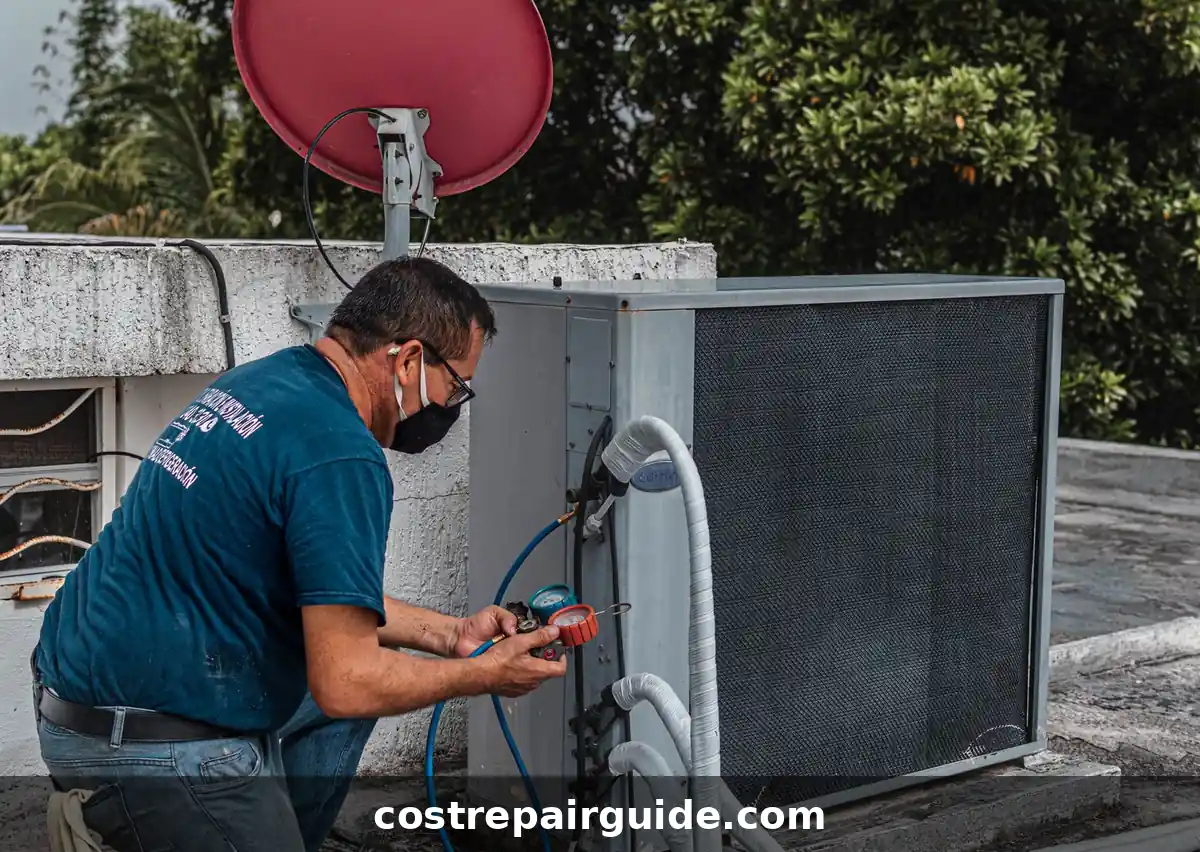
AC repair cost in 2026 range from $150 to $650 for most common residential repairs, with a national average of $350. Simple fixes, capacitor, drain line, thermostat, run $80 to $400. Mid-range repairs like a fan motor, refrigerant leak, or electrical board run $200 to $800. Major repairs, compressor, evaporator coil, condenser coil, run $800 to $2,800 or more. A service call or diagnostic fee of $75 to $200 applies before any repair work begins on most calls.
Home AC repair cost in this guide refers to residential central air conditioning systems. If you searched for car AC repair cost, that is a different repair category with a different cost structure; this guide covers home HVAC systems only.
AC Repair Cost by Repair Type 2026 Data
Most AC repair costs come down to which part failed. This table covers the most common repairs homeowners pay for, based on 2026 contractor pricing across nine sources.
Always ask for an itemized quote showing the part cost, labor rate, service call fee, and any refrigerant charges separately. A single total number tells you nothing about where the money is going.

Repair Type | Typical Cost Range | Notes |
Service call / diagnostic fee | $75 to $200 | Charged before any repair; ask if applied toward work |
Filter replacement/airflow fix | $0 to $50 | DIY possible; do this first before calling |
Drain line cleaning | $75 to $250 | Most common preventable call |
Thermostat repair or replacement | $80 to $500 | Smart thermostat = higher end |
$150 to $400 | Most common repair call; often misquoted high | |
Contactor replacement | $150 to $350 | Controls power to compressor and fan |
Fan motor (condenser) | $200 to $700 | Outdoor unit fan; access affects labor |
Electrical board/control board | $300 to $650 | Brand-specific; OEM costs more |
Refrigerant leak repair + recharge | $200 to $1,500 | R-410A $100-320/recharge; R-22 $180-600+ |
Evaporator coil repair or replacement | $600 to $2,400 | Indoor coil; sealed system access required |
Condenser coil repair or replacement | $1,200 to $4,200 | Outdoor unit; refrigerant handling adds cost |
Air handler replacement | $1,500 to $3,400 | Full indoor unit; includes installation |
$800 to $2,800 | Most expensive single repair; compare to a new system |
AC Repair Cost by System Type
Central AC repair cost, window AC repair cost, and ductless mini-split repair costs are all different. Here is a quick comparison.
AC Type | Typical Repair Range | Avg Minor Repair |
Central AC (ducted) | $150 to $2,800+ | $350 |
Ductless mini-split | $150 to $1,500 | $300 |
Window AC unit | $100 to $350 | $175 |
Heat pump (same system) | $150 to $2,500 | $400 |
Portable AC | $100 to $300 | $150 |
Window AC repair cost are low, $100 to $350, but many repair technicians will tell you that for a window unit under $500, replacement often makes more sense than repair once the service call fee is factored in. A new mid-range window unit costs $150 to $350 installed by yourself.
Common AC Problems and What They Cost to Fix
AC Blowing Warm Air
This is the most common summer complaint and the widest range in repair cost. The cheapest cause is a dirty air filter blocking airflow, a $0 to $50 fix. The most expensive cause is a failed compressor, an $800 to $2,800 repair. Between those extremes are a bad capacitor ($150 to $400), a refrigerant leak ($200 to $1,500), and a frozen evaporator coil (which may cost nothing to fix if the underlying cause is resolved). Always confirm the diagnosis before approving any repair for this symptom.
AC Water Leak Dripping Near Indoor Unit
AC water leak repair cost run $75 to $350 for the most common cause: a clogged condensate drain line. The AC removes humidity from indoor air, and that moisture collects and drains away. When the drain clogs, water backs up and drips down the air handler onto the floor or ceiling below. This repair is simple and often preventable with annual maintenance. If you see water, turn the system off immediately; running with a backed-up drain can damage electronics.
AC Not Turning On
A system that will not turn on at all is often a thermostat or electrical issue rather than a major mechanical failure. Check the thermostat batteries, confirm the mode is set to cool, and check the breaker before calling anyone. If the system has power but will not start, a failed capacitor or contactor is the most common cause; both are in the $150 to $400 range.
AC Short Cycling: Turning On and Off Too Quickly
Short cycling means the system starts, runs for a few minutes, shuts off, and then starts again in a repeating pattern. Common causes include an oversized system, a dirty filter, low refrigerant, or a failing thermostat. Ignoring short cycling accelerates wear on the compressor, the most expensive component. Address it promptly.
AC Making Loud or Unusual Sounds
Banging or clanking usually means a loose or broken part inside the outdoor unit. Squealing often points to a worn fan belt or bearing. Grinding means motor bearing failure. Clicking at startup is often the capacitor struggling to start the motor. None of these improve on their own. Continued operation with these sounds typically turns a mid-range repair into a major one.
AC Leak Repair Cost: Refrigerant vs Water
Two different problems use the word ‘leak’ in AC repair, and they cost very different amounts to fix. Make sure you know which one you are dealing with.
Refrigerant Leak
AC refrigerant leak repair costs run from $200 to $1,500 and cover leak detection, fixing the leak source, and recharging the system. These three steps are all separate costs that should be itemized in your quote.

Refrigerant Leak Step | Typical Cost | Notes |
Leak detection test | $100 to $330 | UV dye or electronic detector |
Leak repair (small) | $100 to $400 | Accessible coil or line repair |
Leak repair (major, coil) | $600 to $2,400 | Evaporator or condenser coil replacement |
R-410A recharge (2-4 lbs typical) | $100 to $320 | At $50-80/lb; price rising with phase-down |
R-22 recharge (old systems) | $180 to $600+ | R-22 no longer produced in the US; scarce |
AC freon leak repair cost note: ‘freon’ is a brand name commonly used for R-22 refrigerant, which was phased out in 2020. If your system uses R-22, a refrigerant leak repair can cost significantly more than the same repair on a newer R-410A system. An older system needing a major refrigerant repair is a strong candidate for replacement.
AC coil leak repair cost and AC line repair cost: A leak in the evaporator or condenser coil typically requires coil replacement rather than repair, at $600 to $2,400. A leak in the copper line set connecting the two units runs $150 to $600.
Water Leak
AC water leak repair cost of $75 to $350 cover the condensate drain, pan, or pump, completely separate from the refrigerant system. Water leaking near the indoor unit is almost always a drain issue. Refrigerant leaks do not produce visible water; they produce reduced cooling performance and eventually ice formation on the coils.
What Affects AC Repair Cost
Which Part Failed
The failed component drives more of the price than any other single factor. A capacitor repair costs a fraction of what a compressor or coil replacement runs. Before approving any repair, confirm the technician identified the specific failed component through testing, not just symptom matching.
AC Repair Cost Per Hour Labor
AC repair cost per hour runs $75 to $150 during standard business hours, and up to $250 per hour for complex repairs requiring multiple technicians. Emergency and after-hours calls typically add $40 to $80 per hour on top of the standard rate. The total labor time depends on the repair type: a capacitor swap takes one hour, and a compressor replacement takes four to six hours.
The Summer Tax
Air conditioners fail most often in summer, exactly when HVAC companies are at their busiest. High demand during heat waves pushes labor rates up and reduces scheduling flexibility. The same repair that costs $300 in April may cost $400 to $450 in July, not because the part changed, but because the technician’s time is worth more when everyone needs help at once. If the repair can safely wait, fall or spring scheduling saves real money.
Emergency Service Premium
Emergency AC repair cost adds a meaningful premium on top of the base repair. Weekend service typically costs 1.5 to 2 times the standard labor rate. Evening and holiday calls add $50 to $150 flat plus the higher hourly rate. For a $300 standard repair, emergency service can push the total to $450 to $600 for the identical work.
System Age and Refrigerant Type
Older systems cost more to repair because parts are harder to source and the refrigerant type may be expensive. A system still using R-22 faces meaningfully higher recharge costs than one using R-410A. If the system is 12 or more years old and uses R-22, compare the full repair cost against a replacement before approving any major work.
Warranty Coverage
A manufacturer warranty typically covers major parts like the compressor for 5 to 10 years but does not cover labor. If your system is under 10 years old, always check warranty status before paying for any major component. A covered compressor can turn a $2,000 repair into a $400 to $600 labor-only bill.
AC Repair Cost Near Me
Your local AC repair cost near me depends on your regional labor market, seasonal demand, and which part failed. Urban areas charge more per hour than rural markets. The same capacitor replacement that costs $200 in a small town can cost $350 in a major metro.
When comparing local quotes, ask each company to itemize the diagnostic fee, part cost, labor rate, and any refrigerant charges. A quote that looks lower may exclude the service fee, use aftermarket parts, or skip a labor warranty. Compare line items, not just totals.
Repair or Replace the AC System?
This is the question behind every major repair quote. Here is a clear framework for making the decision.
The $5,000 Rule: Multiply the system’s age in years by the repair cost in dollars. If the result exceeds $5,000, replacement is usually the smarter long-term investment. Example: A 10-year-old system needing a $600 repair = $6,000. Compare against a new system. A 5-year-old system needing the same $600 repair = $3,000. Repair makes sense. A $1,500 repair on a 10-year-old system = $15,000. Replacement is the better call.
|
Your Situation |
Better Choice |
Why |
|
System under 8 years old, minor part |
Repair |
Most useful life remains |
|
Capacitor, thermostat, drain, contactor |
Repair |
Affordable, isolated, almost always worth fixing |
|
Fan motor or control board failed |
Compare, check age |
Mid-cost repair; factor in system age |
|
System is 10 to 12 years old |
Compare both |
Other parts approaching end of life |
|
Compressor failed, no warranty |
Strongly consider replacement |
Repair cost close to new system value |
|
System uses R-22 refrigerant |
Lean toward replacement |
R-22 no longer produced; costs keep rising |
|
Repair exceeds 50% of new system cost |
Replace |
New system is better long-term value |
|
Frequent repairs, third time in 2 years |
Replace |
Add up what you have already spent |
A new central AC system costs $3,000 to $7,500 installed. If a compressor repair quote is $1,800 on a 12-year-old system, the gap between repair and replacement is $1,200 to $5,700. That gap closes fast when you factor in the age of every other component and the likelihood of the next repair.
The 5-Minute Checklist Before You Call a Technician
A service call costs $75 to $200 before any repair begins. These five checks take five minutes and resolve a meaningful number of AC calls at zero cost. According to HVAC technicians, a dirty filter, wrong thermostat setting, or tripped breaker accounts for roughly one in five service calls.
If none of these resolve the problem, then the call is warranted. But completing this list first means you have already ruled out the simplest and cheapest causes before spending $75 to $200 on a diagnostic.
Questions to Ask Before Approving AC Repair
A Confession About AC Repair Quotes
The hardest part of a summer AC repair call is not the bill. It is the combination of discomfort, urgency, and zero context for what any of the numbers mean. The technician is there. The house is hot. The quote is on the table. And you have never once thought about what a capacitor should cost.
That combination makes the average homeowner approve almost any quote. Not because they trust the number. But because the alternative is sitting in a hot house while you try to research something you have never needed to understand before.
Here is what helps. Knowing that most common repairs cost $150 to $650. Knowing that a capacitor is a $150 to $400 repair, not a $900 repair. Knowing that if the quote is for compressor replacement, you should ask specifically whether replacing the whole unit might cost only a few hundred dollars more and come with a new warranty and 15 years of fewer repair calls.
That context does not make every technician honest. It makes you harder to confuse, which is the same outcome for a fraction of the cost.
The Repair That Costs $0: Filter Changes
A clogged air filter is behind a disproportionate number of AC repair calls. Restricted airflow causes the evaporator coil to freeze, the compressor to strain, and the system to short cycle, all of which look like mechanical failures and result in service calls that cost $75 to $200 just to diagnose.
Changing or cleaning your filter every one to three months, depending on household conditions, eliminates most of these calls before they happen. A filter costs $5 to $25. That is the cheapest AC repair available.
Annual professional maintenance catches everything else- early refrigerant loss, worn contactors, dirty coils- before they become emergency calls. See: HVAC Maintenance Cost.
Frequently Asked Questions
Final Thoughts
AC repair cost in 2026 averages $350, with a typical range of $150 to $650 for most common residential repairs. The failed part drives more of the price than anything else. A capacitor is a few hundred dollars. A compressor is a few thousand.
Home AC repair cost also depends on timing: summer demand raises rates, emergency service adds a premium, and R-22 systems face higher refrigerant costs than current R-410A equipment.
Get the itemized quote before approving any work. Check warranty status before paying for parts. Run the $5,000 rule before approving any major repair on an older system. And complete the 5-minute checklist before calling; one in five service calls is resolved by a filter change or thermostat setting.